
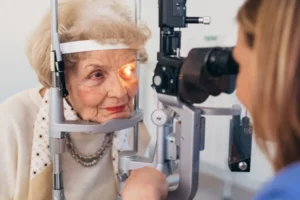
 Our bodies and eyes change as we age. This is especially true in important parts such as the retina, lens, cornea, and optic nerve, which can change in structure and function. This may cause blurry vision, difficulty distinguishing between light and dark, and trouble adjusting to varying light levels. Some changes are expected and nothing to worry about, but others could be a sign of eye disease. Therefore, it is important to identify and treat these eye issues early to preserve our vision and quality of life.
The Importance of Regular Eye Examinations
The American Academy of Ophthalmology (2023) recommends that adults 65 and older have a comprehensive eye exam, including pupil dilation, at least once a year. Common eye problems that come with age, such as glaucoma, cataracts, and macular degeneration, often don’t have clear symptoms until significant damage has occurred. Routine eye exams can detect these problems early by checking eye pressure, lens clarity, the health of the optic nerve, and the retina’s function, allowing for quick care.
Common Age-Related Eye Conditions
Cataracts
Cataracts develop when the eye’s natural lens becomes cloudy due to oxidation and protein clumping (1). People with cataracts often find bright lights bothersome, experience blurry vision, see colors as dull, and have trouble seeing at night. Surgery to treat cataracts, which involves removing the cloudy lens and replacing it with a new one, is successful in more than 90% of cases worldwide (2).
Age-Related Macular Degeneration (AMD)
Macular degeneration, which occurs with age, damages the macula, the part of the eye responsible for clear central vision. Research on eye problems linked to aging found that taking supplements containing vitamins C and E, beta-carotene, zinc, and copper can slow the progression of severe macular degeneration by about 25% for those at high risk (3). Recent studies also emphasize that changing daily habits, such as quitting smoking, eating healthier, and managing heart-related issues, are very important for effectively managing the disease (4).
Glaucoma
Glaucoma is a term used to describe a group of optic nerve diseases that lead to the progressive loss of retinal ganglion cells, often associated with increased intraocular pressure. Since early-stage glaucoma typically does not show any symptoms, regular screening is essential. Research has shown that initiating early treatment to lower intraocular pressure can significantly reduce the risk of vision loss in the visual field (5).
Dry Eye Disease
As people age, dry eye (keratoconjunctivitis sicca) becomes more common, mainly because the eyes produce fewer tears and the meibomian glands don’t function properly. Those with this condition often experience a burning sensation in their eyes, redness, the feeling that something is in their eye, and possible changes in vision. Research shows that the best way to treat this condition is to use several methods, including eye drops to add moisture, medicines to reduce swelling, changes in daily habits, and special treatments at the doctor’s office to help keep tears stable (6).
Evidence-Based Strategies for Preserving Vision
- An annual comprehensive eye exam can detect issues early and help prevent vision loss (7).
- Eating healthy foods such as leafy green vegetables, omega-3 fats, and colorful plant pigments (like lutein and zeaxanthin) can help lower your chance of getting an eye disease called AMD and cataracts as you get older(8).
- Using sunglasses that block at least 99% of harmful sun rays is important to protect your eyes’ inner parts from damage.
- Taking care of your health and conditions such as high blood pressure, diabetes, and cholesterol is essential for maintaining good retina and optic nerve health (9).
- Quitting smoking is one of the most effective ways to protect against AMD and cataracts (10).
- Proper lighting and a safe space can ease the strain on the eyes and prevent falls for older adults (11).
- The Broader Impact of Vision Preservation
Vision health influences far more than sight—it directly affects independence, cognitive function, and emotional well-being. A long-term study from 2022 showed that older people with problems seeing or with both sight and hearing issues were much more likely to feel sad or depressed over time, proving that senses and mental health are connected (12). Maintaining optimal vision through early detection and management of eye disease, therefore, plays a critical role not only in preserving functional ability but also in supporting mental and emotional quality of life.
Expert Vision Care for Older Adults
At Nova Eye Institute, our eye doctors use advanced technologies such as optical coherence tomography (OCT), visual field testing, and digital retinal imaging. We combine these tools with proven treatments and clear patient education.
If you are 60 years or older, or if it has been more than a year since your last eye exam, we recommend scheduling a comprehensive evaluation. Taking care of your eye health today helps ensure your independence tomorrow.
References
- Pascolini, D., & Mariotti, S. P. (2012). Global estimates of visual impairment: 2010. The British Journal of Ophthalmology, 96(5), 614–618. https://doi.org/10.1136/bjophthalmol-2011-300539
- Liu, Y. C., Wilkins, M., Kim, T., Moggach, S., & Mehta, J. S. (2017). Cataracts. The Lancet, 390(10094), 600–612. https://doi.org/10.1016/S0140-6736(17)30544-5
- Age-Related Eye Disease Study Research Group. (2001). A randomized, placebo-controlled, clinical trial of high-dose supplementation with vitamins C and E, beta carotene, and zinc for age-related macular degeneration and vision loss: AREDS report no. 8. Archives of Ophthalmology, 119(10), 1417–1436. https://doi.org/10.1001/archopht.119.10.1417
- Keenan, T. D. L., et al. (2021). Age-related macular degeneration. The Lancet, 397(10292), 1420–1434. https://doi.org/10.1016/S0140-6736(21)00358-3
- Heijl, A., Leske, M. C., Bengtsson, B., Hyman, L., Bengtsson, B., & Hussein, M. (2002). Reduction of intraocular pressure and glaucoma progression: Results from the Early Manifest Glaucoma Trial. Archives of Ophthalmology, 120(10), 1268–1279. https://doi.org/10.1001/archopht.120.10.1268
- Stapleton, F., Alves, M., Bekefi, Z., et al. (2017). TFOS DEWS II epidemiology report. The Ocular Surface, 15(3), 334–365. https://doi.org/10.1016/j.jtos.2017.05.003
- Craig, J. P., et al. (2017). TFOS DEWS II definition and classification report. The Ocular Surface, 15(3), 276–283. https://doi.org/10.1016/j.jtos.2017.05.008
- Chiu, C. J., & Taylor, A. (2017). Nutritional antioxidants and age-related cataract and maculopathy. Experimental Eye Research, 156, 38–46. https://doi.org/10.1016/j.exer.2016.03.003
- Cheung, N., Mitchell, P., & Wong, T. Y. (2019). Diabetic retinopathy. The Lancet, 376(9735), 124–136. https://doi.org/10.1016/S0140-6736(09)62124-3
- Velilla, S., Garcia-Moreno, J. M., & López-Moreno, J. M. (2013). Smoking and age-related macular degeneration: Review and update. Journal of Ophthalmology, 2013, 895147. https://doi.org/10.1155/2013/895147
- Lord, S. R., Sherrington, C., & Menz, H. B. (2021). Falls in older people: Risk factors and strategies for prevention (3rd ed.). Cambridge University Press. https://doi.org/10.1017/9781108594969
- Longitudinal Associations of Self‑Reported Visual, Hearing, and Dual Sensory Difficulties With Symptoms of Depression Among Older Adults in the United States — Killeen, O.J., Xiang, X., Powell, D., Reed, N.S., Deal, J.A., Swenor, B.K. & Ehrlich, J.R. (2022). Frontiers in Neuroscience, 16, 786244. https://doi.org/10.3389/fnins.2022.786244 frontiersin.org